What Factors Affect Braking Efficiency?

Time:2026-10-03 Author:Madeline
0%

Braking efficiency is not determined by one component alone. It emerges from the interaction between tire grip, brake torque, vehicle weight, road conditions, and driver control. Understanding what factors affect braking efficiency helps drivers, engineers, and fleet managers evaluate stopping performance more accurately.

Racing engineer Carroll Smith wrote, “Brakes are to get you slow enough to make the corner, not to stop you.” His observation highlights an important principle: braking is a system, not merely a pedal action. Tire temperature and tread condition control available friction. Worn pads, glazed rotors, or contaminated brake fluid can reduce stopping force. Heat matters, too. Repeated hard braking may cause brake fade, producing a longer and softer pedal.

Vehicle speed changes everything. Kinetic energy rises sharply as speed increases, so stopping from 100 km/h demands far more energy management than stopping from 50 km/h. Weight distribution also shifts during deceleration. The front axle carries more load, while the rear axle becomes easier to lock. Modern anti-lock braking systems help manage this imbalance, but they cannot overcome bald tires or standing water.

Road texture matters.

Testing should include cold and hot conditions, different loads, and varied surfaces. In practice, measurements may not perfectly match real driving. That is worth admitting. A laboratory result can look impressive while a mountain road reveals weaknesses. Reliable evaluation therefore combines inspection, controlled testing, maintenance records, and experienced observation. This guide examines each influence clearly, with practical details that support safer decisions and more consistent braking performance.
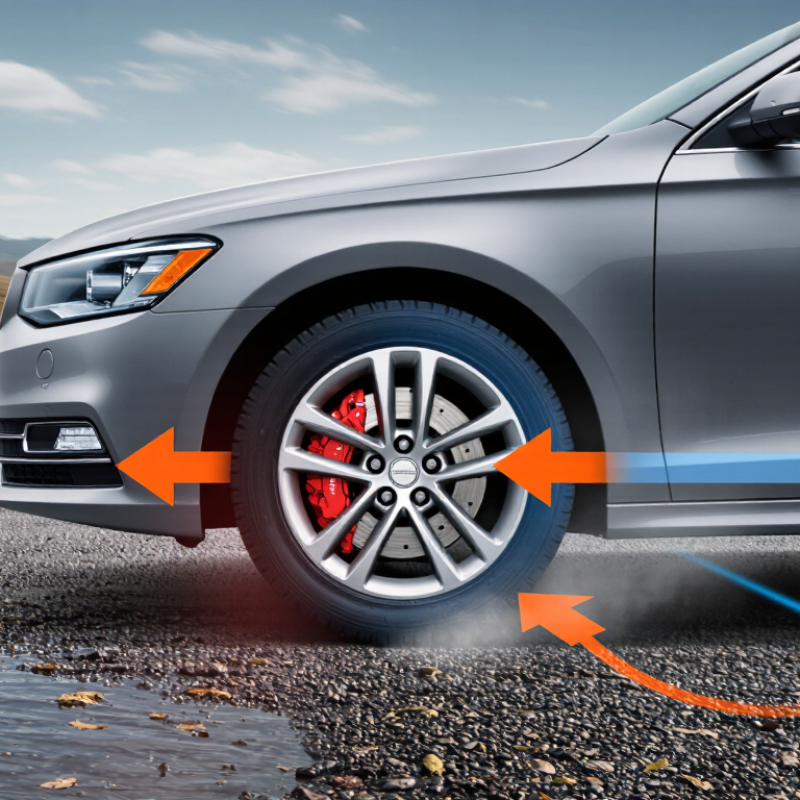
What Factors Affect Braking Efficiency?

How Braking Efficiency Is Defined and Measured

Braking efficiency describes how effectively a vehicle converts pedal input into controlled deceleration. In practical testing, it is often expressed as braking force divided by vehicle weight, multiplied by 100. A 50% result means the measured braking force equals half of the vehicle’s weight. The UK Driver and Vehicle Standards Agency (DVSA) uses a 50% service-brake efficiency threshold for many passenger vehicles during MOT testing.

That figure is only one measurement. Road testers also record stopping distance, average deceleration, pedal force, and left-to-right brake balance. UNECE Regulation No. 13-H defines test conditions involving vehicle load, speed, tyre grip, and brake temperature. These details matter. A car stopping from 100 km/h on dry asphalt may perform very differently after repeated stops. The brakes can feel firm, yet heat can reduce friction. This is brake fade.

The test surface changes the answer. Wet pavement, worn tyres, low inflation, and uneven loading can lengthen stopping distance. NHTSA testing guidance therefore treats road surface, temperature, and vehicle condition as important controls. A roller brake tester can identify weak axle performance, but it cannot fully recreate a wet emergency stop. That limitation deserves attention. One percentage can look precise while hiding real driving conditions. I would compare cold and hot results, inspect brake-force balance, and repeat measurements under consistent conditions.

Key Vehicle and Brake System Factors

What Factors Affect Braking Efficiency?

Key Vehicle and Brake System Factors

Braking efficiency depends on more than pressing the pedal. Vehicle weight, speed, tire grip, and road condition all influence stopping distance. A fully loaded vehicle needs more braking force than an empty one. Wet asphalt can reduce tire traction within seconds. Cold tires may also respond less predictably.

The brake system must convert motion into controlled heat. Worn brake pads reduce friction and may increase pedal travel. Thin rotors can overheat faster during repeated stops. Old or contaminated brake fluid can create a soft pedal. Air in the hydraulic lines feels similar. It should not be ignored.

Small details matter.

During inspections, I check tire pressure, tread depth, pad thickness, rotor surfaces, and fluid condition. Uneven pad wear may indicate a sticking caliper or alignment problem. The anti-lock braking system also needs working sensors and stable electrical connections. It helps maintain steering control, but it cannot overcome poor tires or excessive speed.

Driver behavior remains important. Following too closely removes valuable reaction time. Carrying heavy cargo changes the vehicle’s balance and braking response. I have sometimes trusted a normal pedal feel too quickly; measurements revealed uneven wear underneath. That experience is worth remembering. Brakes can feel acceptable before their performance becomes unsafe. Regular professional checks provide better evidence than sound, smell, or personal confidence.

How Road, Weather, and Tire Conditions Affect Braking

What Factors Affect Braking Efficiency?

How Road, Weather, and Tire Conditions Affect Braking

Braking efficiency begins with the road surface. Dry, clean asphalt usually provides strong tire grip, while loose gravel reduces stability and control. Wet roads create a thin water layer between rubber and pavement. At higher speeds, this layer can cause hydroplaning. The effect can feel sudden.

Weather changes braking behavior in less obvious ways. Cold temperatures may harden tire rubber and reduce traction. Snow and ice lower friction dramatically, even when the road appears clear. Rain also reduces visibility, making delayed reactions more likely. Drivers should increase following distance before conditions worsen.

Tire condition matters every day. Correct air pressure helps maintain the intended contact patch and keeps braking more predictable. Underinflated tires can respond slowly, while excessive pressure may reduce grip on uneven surfaces. Worn tread cannot move water away effectively. Check it regularly.

Speed matters greatly. A vehicle traveling faster carries much more energy during braking. A small speed increase can add a surprising amount of stopping distance. Brakes may also lose performance after repeated hard stops because heat builds in the system. This detail is easy to overlook.

A simple rule can mislead. Good tires cannot overcome ice, and advanced braking systems cannot replace cautious driving. I would also recheck tire pressure after major temperature changes, since readings can shift overnight. That small habit is easy to forget.

What Factors Affect Braking Efficiency? — How Road, Weather, and Tire Conditions Affect Braking
Condition Typical Tire–Road Grip Approximate Braking Distance at 50 km/h Effect on Braking Efficiency Why It Matters Recommended Action
Dry, clean asphalt High friction; approximately 0.70–0.90 About 10–14 m Baseline condition Provides strong tire adhesion and allows the braking system to convert vehicle speed into heat efficiently. Maintain a safe following distance and brake progressively rather than waiting until the last moment.
Wet asphalt Moderate friction; approximately 0.40–0.60 About 14–20 m Reduced grip Water forms a lubricating film between the tire tread and road surface, increasing stopping distance. Reduce speed, increase following distance, and avoid abrupt steering or braking inputs.
Standing water Unstable friction; varies widely Can exceed 20 m Significantly reduced Deep water can cause partial hydroplaning, reducing steering control and the tire’s ability to transmit braking force. Slow down before the water, keep steering movements smooth, and do not use cruise control.
Packed snow Low friction; approximately 0.15–0.25 About 35–60 m Greatly reduced Snow compresses between the tread and road, limiting available traction even when the brakes are functioning correctly. Use winter-appropriate tires, drive slowly, and leave substantially more space for stopping.
Glazed ice Very low friction; approximately 0.05–0.15 About 70 m or more Extremely reduced Ice provides very little resistance to tire movement, so braking, steering, and acceleration all become less effective. Avoid travel when possible; otherwise reduce speed sharply and use gentle, controlled inputs.
Tires with adequate tread and pressure Optimized contact and water evacuation Supports the road-condition values above Best available performance Correct inflation and sufficient tread help maintain a stable contact patch and channel water away from the tire. Check pressure when tires are cold and replace tires before tread depth reaches the legal or safety limit.
Underinflated tires Less stable contact; increased sidewall flex Distance may increase, especially in wet conditions Reduced and less predictable Low pressure can distort the contact patch, increase heat buildup, and impair handling during emergency braking. Check pressure regularly and follow the vehicle manufacturer’s recommended cold-tire pressure.
Worn or unsuitable tires Reduced tread and water displacement Often substantially longer on wet roads Reduced, particularly in rain Shallow or hardened tread cannot remove water effectively and may lose grip earlier during braking. Replace damaged, aged, or excessively worn tires and use tires suited to the season and climate.
Cold temperatures Depends on tire compound and road surface May increase on cold or icy roads Variable reduction Tire rubber can become less flexible, while frost or ice can sharply lower the road’s available friction. Allow extra stopping space and use tires designed for the expected temperature range.
Vehicle load and downhill slope Grip may remain similar, but demand increases Longer distance is possible Higher braking demand Additional mass increases the energy that must be dissipated; a downhill gradient also adds the force of gravity. Reduce speed before descending, use a suitable lower gear, and avoid repeated heavy braking.
Approximate values assume a properly maintained passenger vehicle traveling at 50 km/h and describe braking distance only, excluding driver reaction time. Actual results vary with vehicle type, tire design, brake condition, temperature, road texture, slope, load, and driver input.

The Role of Driver Behavior and Vehicle Load

What Factors Affect Braking Efficiency?

Driver behavior strongly influences how quickly a vehicle can stop. Looking far ahead gives the driver more time to react smoothly. Sudden braking often follows late attention, excessive speed, or following too closely. A calm driver presses the pedal firmly and keeps the vehicle straight. Hands should remain steady, especially when braking on a wet or uneven road. Small distractions can add several meters before braking even begins.

Vehicle load changes braking performance in less obvious ways. Extra passengers, tools, or luggage increase the vehicle’s mass. More mass usually requires a longer stopping distance and creates greater heat in the braking system. Poorly placed cargo can also shift the vehicle’s balance during hard braking. Heavy items should stay low and close to the vehicle’s center. Loose objects should be secured. They can move forward during sudden stops.

Tire condition and brake maintenance still matter, but driver choices often decide the final outcome. A heavily loaded vehicle needs more following space than an empty one. This is especially important on downhill roads or in rain. Controlled road tests support this practical advice, although conditions never match perfectly. It is tempting to trust modern safety systems too much. They assist the driver, but they cannot defeat physics. Even experienced drivers can misjudge a loaded vehicle’s response, particularly after changing from daily driving to a long trip.

Methods for Improving and Maintaining Braking Efficiency

What Factors Affect Braking Efficiency?

Braking efficiency depends on more than pad thickness. Heat, fluid condition, tire grip, axle loading, rotor runout, and ABS calibration all influence stopping performance. In workshop inspections, a vehicle may feel normal during gentle braking, yet fade after repeated stops. That hidden change matters on a downhill road.

The Commercial Vehicle Safety Alliance’s 2023 Brake Safety Week inspected 18,875 commercial vehicles.

Of these, 2,375 received brake-related out-of-service violations, equal to 12.6 percent. This result does not represent every passenger vehicle. It does show why visual checks alone are weak.

Improvement starts with measurement.

A qualified technician should check pad thickness, rotor thickness and runout, caliper movement, hose condition, and fluid moisture. Brake fluid absorbs moisture over time, reducing its boiling margin during hard use. Replacing it at a documented service interval can help. However, climate, mileage, and workload should influence that interval.

Correct tire pressure and balanced loading matter too. Limited tire contact can waste good brake hardware. After service, test braking at low speed, then confirm pedal firmness, straight tracking, and ABS operation in a safe area.

Do not ignore vibration. It may indicate uneven rotors, loose wheel hardware, or suspension wear.

One imperfect habit deserves attention: drivers often judge brakes by pedal feel alone. That habit can miss gradual deterioration. A maintenance record with dates, measurements, and photos creates stronger evidence than memory.

FAQS

What does braking efficiency mean?

Braking efficiency shows how effectively pedal input becomes controlled deceleration. It is often calculated as braking force divided by vehicle weight, multiplied by 100. A 50% result means measured braking force equals half the vehicle’s weight. This percentage is useful, but incomplete.

What measurements provide a fuller braking assessment?

Technicians may record stopping distance, average deceleration, pedal force, and left-to-right brake balance. Comparing cold and hot results can reveal hidden heat-related weakness. One number can look precise. It may still hide real road conditions.

How do road and weather conditions affect braking?

Wet pavement reduces tire grip and can lengthen stopping distance. Worn tires, low inflation, and uneven loading make the problem worse. A dry-road stop from 100 km/h may differ greatly after repeated braking. Heat changes everything.

What is brake fade?

Brake fade occurs when repeated braking creates heat and reduces friction. The pedal may still feel firm while stopping performance declines. Thin rotors and heavy loads can increase heat buildup. A downhill road can expose this weakness quickly.

Which brake-system problems can reduce efficiency?

Worn pads may reduce friction and increase pedal travel. Thin rotors can overheat sooner. Old or contaminated fluid may create a soft pedal. Air in hydraulic lines can feel similar. It should not be ignored.

Can the anti-lock braking system overcome poor tires?

No. Anti-lock braking helps maintain steering control during hard braking. It cannot create grip on wet pavement or worn tires. Excessive speed remains dangerous. Working sensors and stable electrical connections are still important.

What should a professional inspection include?

The inspection should check tire pressure, tread depth, pad thickness, rotor thickness, and rotor runout. It should also examine caliper movement, hoses, fluid condition, and wheel hardware. Uneven pad wear may indicate a sticking caliper or alignment problem. Visual checks alone are weak.

How can braking efficiency be maintained after servicing?

Use correct tire pressure and distribute cargo evenly. Replace brake fluid at a documented interval suited to climate, mileage, and workload. Test braking slowly in a safe area after service. Confirm firm pedal feel, straight tracking, and proper anti-lock operation. Do not ignore vibration.

Is pedal feel enough to judge brake condition?

No. A normal pedal can hide gradual wear or unequal braking. I have trusted pedal feel too quickly before. Measurements later showed uneven wear. Service dates, readings, and photographs provide better evidence than memory.

Conclusion

Braking efficiency describes how effectively a vehicle converts braking input into controlled deceleration while maintaining stability, stopping power, and predictable pedal response. It can be measured through stopping distance, deceleration rate, brake balance, heat resistance, and consistency under repeated use. What factors affect braking efficiency include the condition and design of the brake system, pad and rotor performance, hydraulic pressure, brake fluid quality, electronic controls, wheel alignment, suspension condition, and overall vehicle maintenance.

Road surface, rain, snow, temperature, and tire grip can greatly change braking results. Tire pressure, tread depth, and tire condition also influence how well braking force reaches the road. Driver behavior matters as well: smooth, timely braking and proper attention can improve control, while excessive speed, abrupt inputs, distraction, or carrying an unusually heavy load can increase stopping distance. Efficiency can be maintained by inspecting brake components regularly, replacing worn parts, keeping tires correctly inflated, managing vehicle weight, adapting speed to conditions, and responding promptly to warning signs such as vibration, noise, pulling, or a soft pedal.

Madeline

Madeline

Madeline is a dedicated marketing professional with a wealth of expertise in our company's core offerings. With a keen understanding of the industry, she brings a unique perspective to her role, consistently delivering high-quality content that highlights the superior aspects of our products. As......